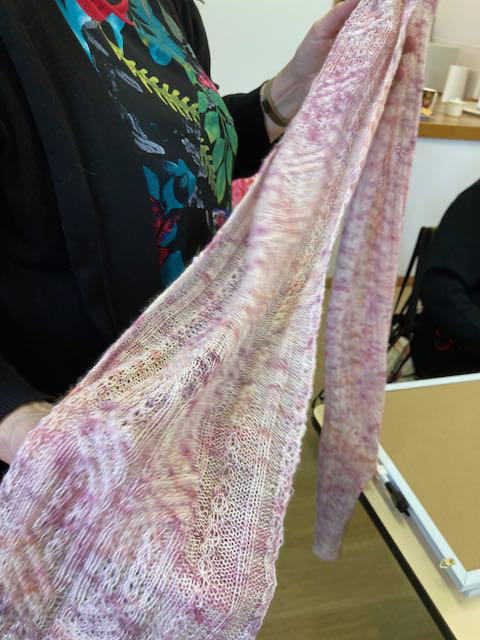
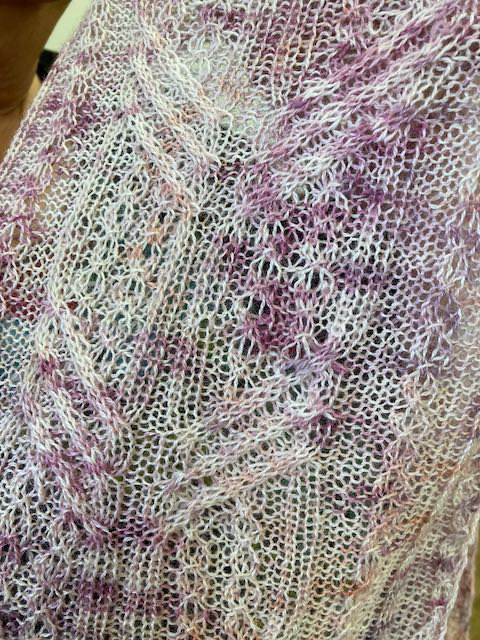
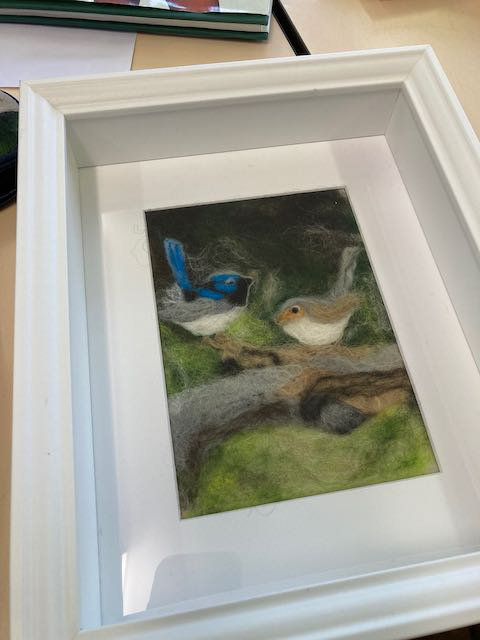
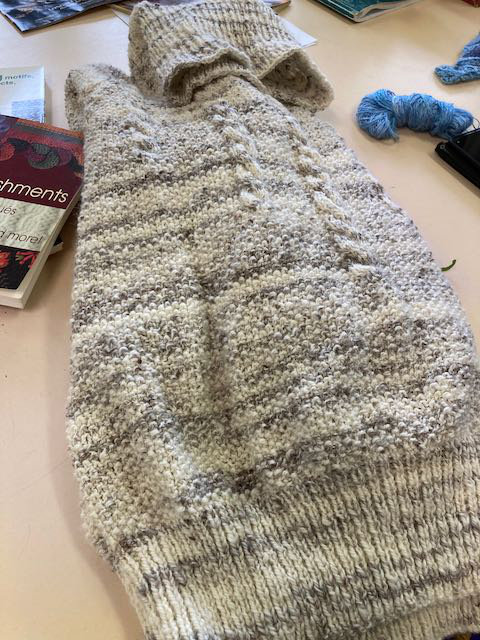
Half way through the year already!

The months are just wizzing past too fast. The Australian Sheep and Wool Show (Bendigo) has been and gone, and sent better weather this year for participants! This years’ featured breed was English Leicester (a personal favourite of mine) and the Woolcraft entries in the featured breed section were simply spectacular! If you are at all active on Social Media you would most likely have seen some photos from the Wool Show pop up – especially those super cute Valais Blacknose sheep. More stories to come next Newsletter.

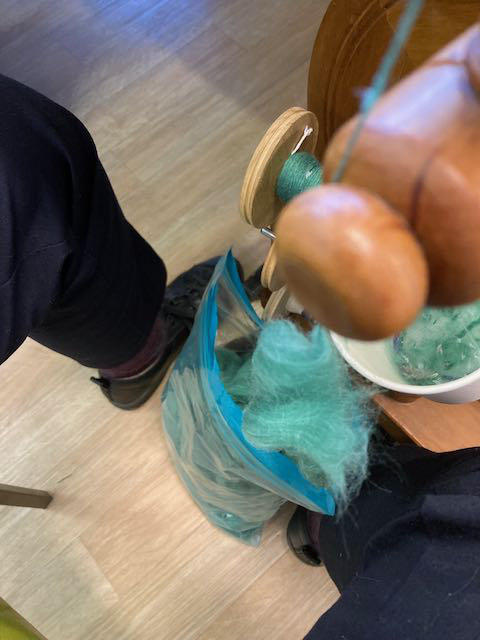
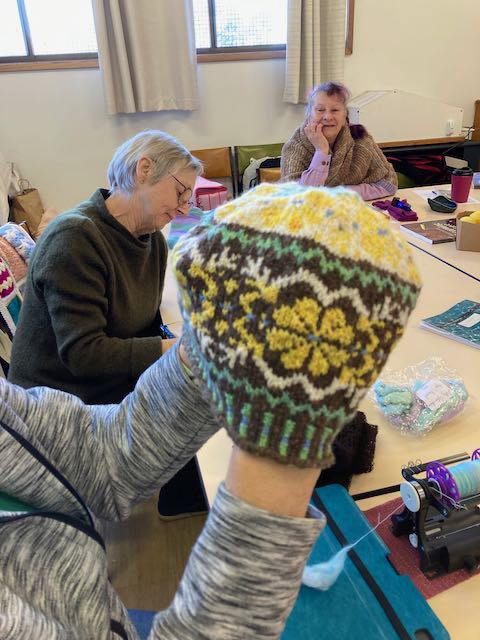
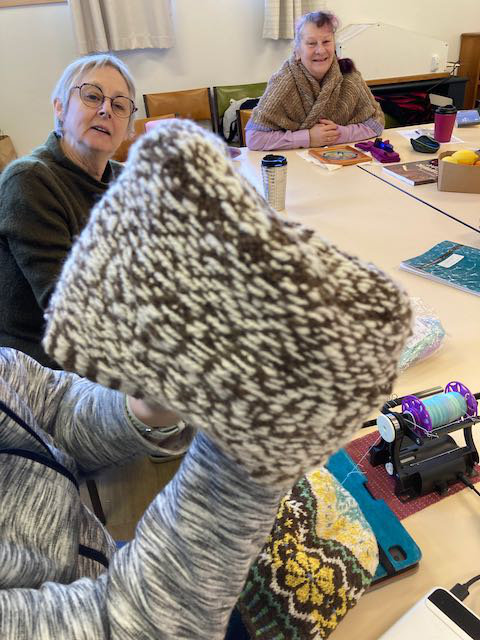
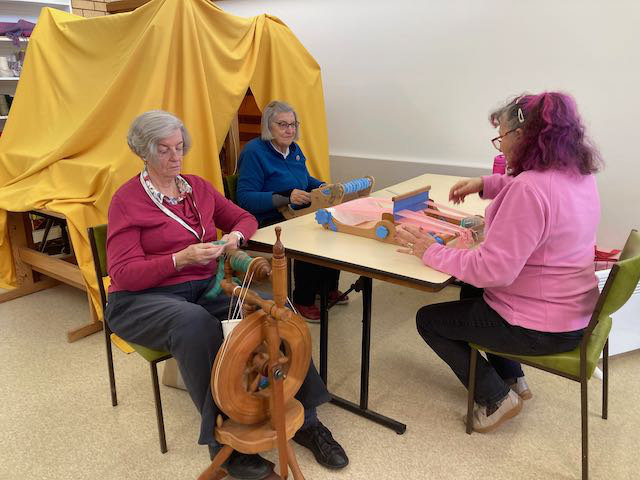
Our Wednesday Guild days are getting quite busy and making great use of the extra space we found after moving tables and stacking the looms. Well ok, not actually “stacking”, just fitting the smaller looms in under the bigger table looms … The electric Drum Carder now has it’s own dedicated table and has moved closer to convenient power. The new arrangements mean there is plenty of room for meetings or workshops on the main tables at the front of the rooms while allowing plenty of space for spinners to set up their wheels at the back. The growing number of e-spinners off course go wherever their owners like.

We’re currently running an informal weaving workshop where members are encouraged to learn to warp their looms and practice basic weaving techniques. It is an ongoing program and open to explore any type of loom – inkle, ridgid heddle, table looms or for the really adventurous our floor looms. We could probably even manage a tapestry loom if anyone was interested. It’s a very loose workshop in that anyone that wanted to try any of them, on any Wednesday, just needs to say so.

There is also a trip scheduled to visit the Cobram Guild on Tuesday 25 August. Car pooling is being arranged and should be fun for all. Contact our secretary, Amanda Eaton, if you’re interested.

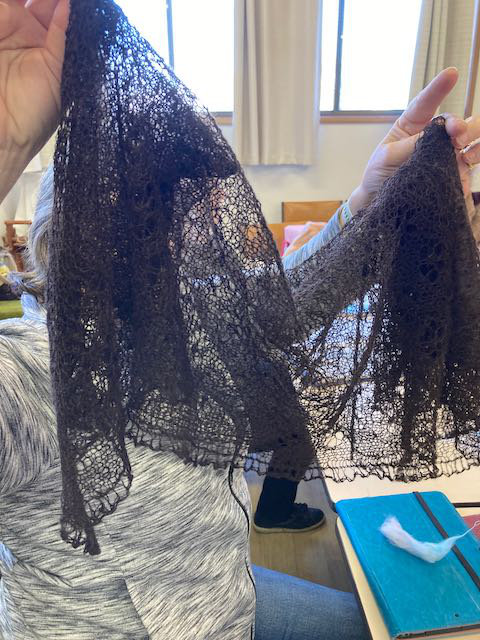
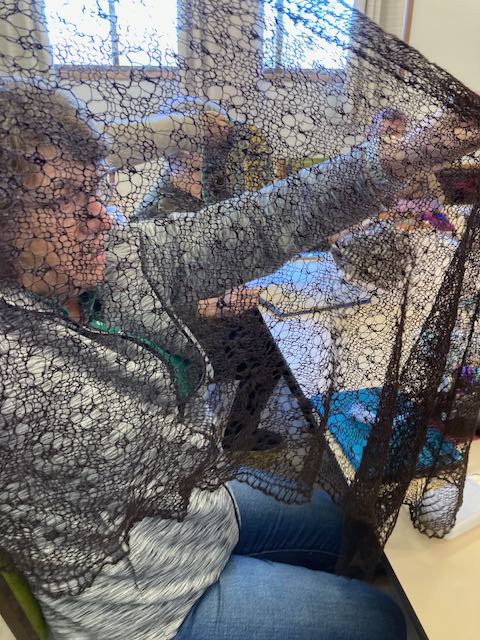
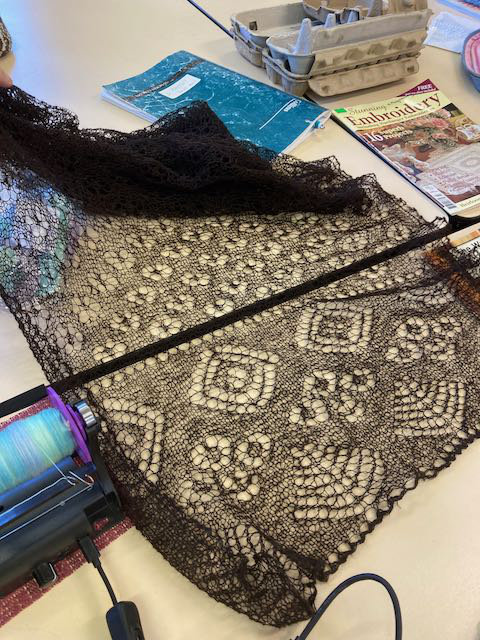
Remember that the Albury Show is coming up, and will probably be here before we know it. We’re planning on having a presence there with a Sheep’s Back to Shawl display, and possibly entries in their competitions.

Cheers all,
KathyW, Editor.

August - September Program

August 1st - 2ndSouth Coast Fibre Muster - from 10.00 am to 3.00 pm Saturday & Sunday. At the Berry School of Arts.
August 5thCasual Workday
August 12thAGM, Business Meeting & Guild’s Birthday
August 19thCasual Workday
August 26thWarping Workshop
September 2ndCasual Workday
September 9thBusiness Meeting
September 16thCasual Workday
September 23rdCasual Workday
September 30thCasual Workday

Committee 2025 – 2026


President:
Deb Carpenter


Vice President:
Darlene Anderson


Secretary (communications/events):
Amanda Eaton


Minute Officer:
Amanda Eaton


Treasurer:
 Rhonda Delahoy


Assistant Treasurer:
Julie Hofer


Social Media Officer:
Kathy Wheeler


Library/Equipment Officer:
Heather Mulqueeney and Rhonda Delahoy


Newsletter Editor:
Kathy Wheeler


Public Officer:
Julie Hofer


KeyHolders Roster
Wednesday Work Days and Meetings

1st Wed of month – Secretary
2nd Wed of month – President
3rd Wed of month – Treasurer
4th Wed of month – Julie or Louise
5th Wed of month *IF* there is one – tba

The Showground Trust also has keys.


Morning Tea Roster 2026 – Business Meeting
11th FebruaryTBA
11th March
8th AprilElla & Jill
6th May
10th JuneJane & Julie
8th JulyRhonda & Heather?
12th AugustLouise & Kathy
9th September
7th October
11th November
9th DecemberEveryone bring a plate!!!

Morning Tea Duties: Arrive a little early. Bring morning tea and milk. Set up morning tea cups, plates etc, boil kettle/urn.

Show & Tell - 10th June 2026

Deb

Louise

Jill

Julie

Ella

Valerie

Amanda

KathyW

Rhonda

Darlene

Heather

Jane

Show & Tell - 8th July 2026

KathyW

Rhonda

Darlene

Heather

Louise

Ella

Jane

Workshop July 2026

IMG_1697_Banner

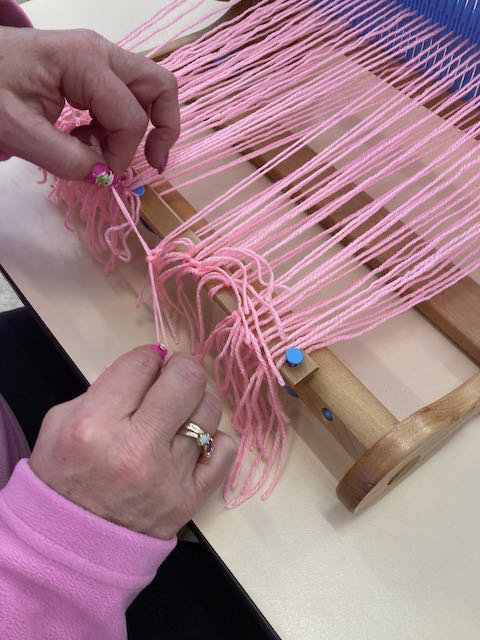
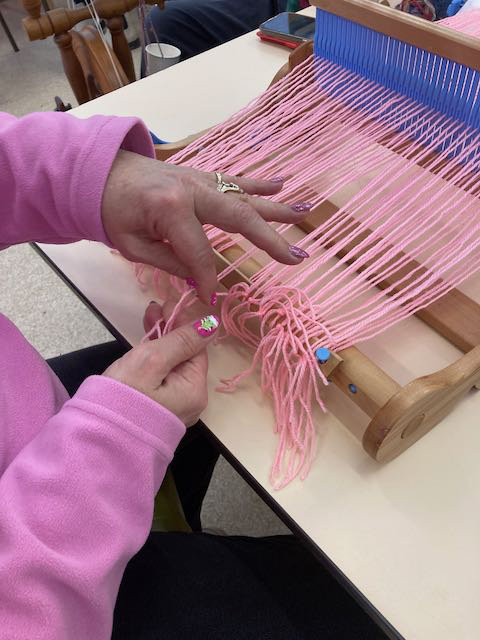
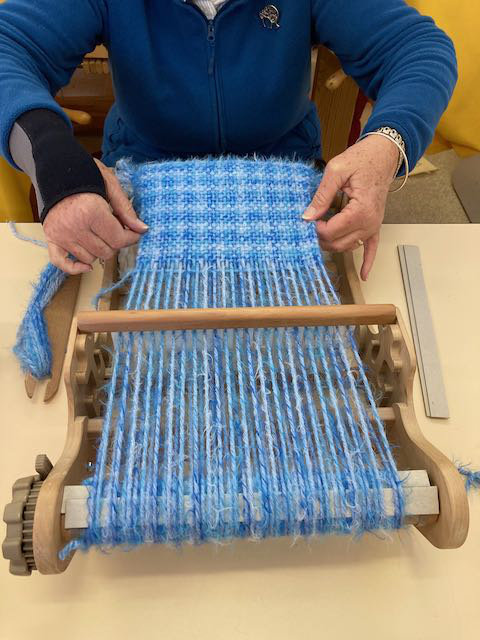
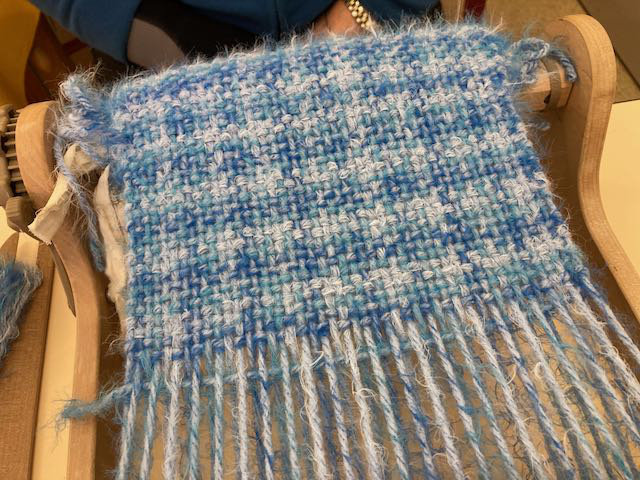
Weaving workshop, progressive style.

“Progressive” in that although the venue does not change, the date does. For the past few weeks a couple of members have been working on rigid heddle weaving projects. Louise has been working, with help from Ella, on warping her rigid heddle loom (photos top right), while Heather has been weaving a piece on her rigid heddle loom (photos bottom right).

Our next dated weaving workshop is for Wednesday 26th of August, when Rhonda and Jane will demo warping table looms.

Book Reviews

We have a wonderful library at the Guild, full of old, new, and rare books and magazines. Here are some of them.

Traditional Knitted Lace Shawls, Martha Waterman, Interweave Press.
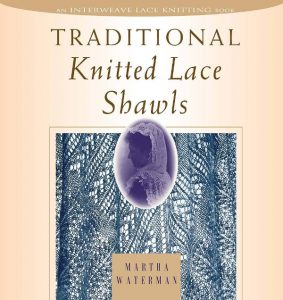
I found this book to be a pleasure to read, informative and with a good range of patterns for lace shawls and wraps.
The author supplied stories and snippets of facts regarding the history and folklore behind many of the traditional patterns. The patterns ranged from easy to follow to more challenging patterns to knit. 
I have to admit that I have not knitted anything from the pattern book yet, but have designs on a fairly simple wrap that I have placed on my ‘to do’ list.
 

Spin Off ( Magazine published by Long thread Media)
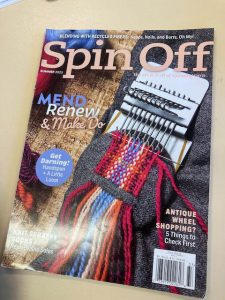
I have been dipping into past copies of Spin Off magazine, despite many years of spinning I find that there is always something to learn, and something to fire up the imagination.
I recently read Spin Off, Summer 2023, ‘ The Mend, Renew and Make Do’ edition, initially attracted by to cover photo of the darning loom, as I have recently purchased this little gadget. The article that most inspired me was knitting socks with Replaceable Soles. (Also now on my ‘to do list) 
I urge you all to take the time to borrow a magazine or two from our library and find something to inspire you.
 
Heather

Learning to Weave, Deborah Chandler, Interweave Press.
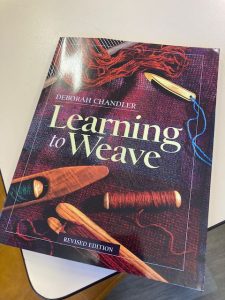
Title:  Learning to Weave
Author: Deborah Chandler
Edition:  Originally published in 1984, and revised in 1994 (as reviewed) and again in 2009.   
Publisher: Interweave
 
This book is one of the most complete introductions to weaving available to new and progressing weavers.    It is structured as a series of lessons which enable the reader to progress from raw beginnings through to more advanced weave structures such as double weave, loom- controlled lace weaves, block theory and overshot.
 
Each lesson is supported by exercises and small projects as applicable.   Answers to exercises, especially warp calculation exercises, are provided at the back of the book so users are not left wondering whether their answers work or not.
 
Whilst the main emphasis is on 4-shafts, notes for 2, 3, 8 and 10 shafts are included for some structures, this making the book an excellent reference for any weaver.   In addition, there are clear instructions for planning projects and calculating yarn requirements.  Diagrams and photos are clear and provide knowledge applicable to any weaver. 
 
Of most importance, though, the book is easy to read, and can be dived into at any point once the basic principles are mastered.  Altogether, an absolute must for any weaver’s bookshelf (with or without You Tube support).

Rhonda.

From the feed

“Bookface” knows more than it lets on, and will not so subtly plant stories to keep you engaged. Sometimes they are even really interesting!

The Vikings built their economy on cloth, not silver.

When we picture Viking-age Iceland, we tend to picture longships, iron, and men. But what powered their commerce?
 
The actual unit of account in Iceland for roughly five centuries was a bolt of woven wool. It was called vadmal. And the Gragas, Iceland’s medieval law-book, fixed its standard precisely: one ounce of value equaled six ells of cloth by two ells wide. That was not informal custom. It was written law.

Debts were settled in it. Rents were paid in it. Fines, tithes, and fees for imported goods were all converted into measured lengths of cloth and exchanged like banknotes.

There were no mints in Iceland during this period. The island had almost no silver coinage in circulation. Vadmal was the medium of exchange because it was the one thing Icelanders could produce reliably and trust universally.

Who produced it?

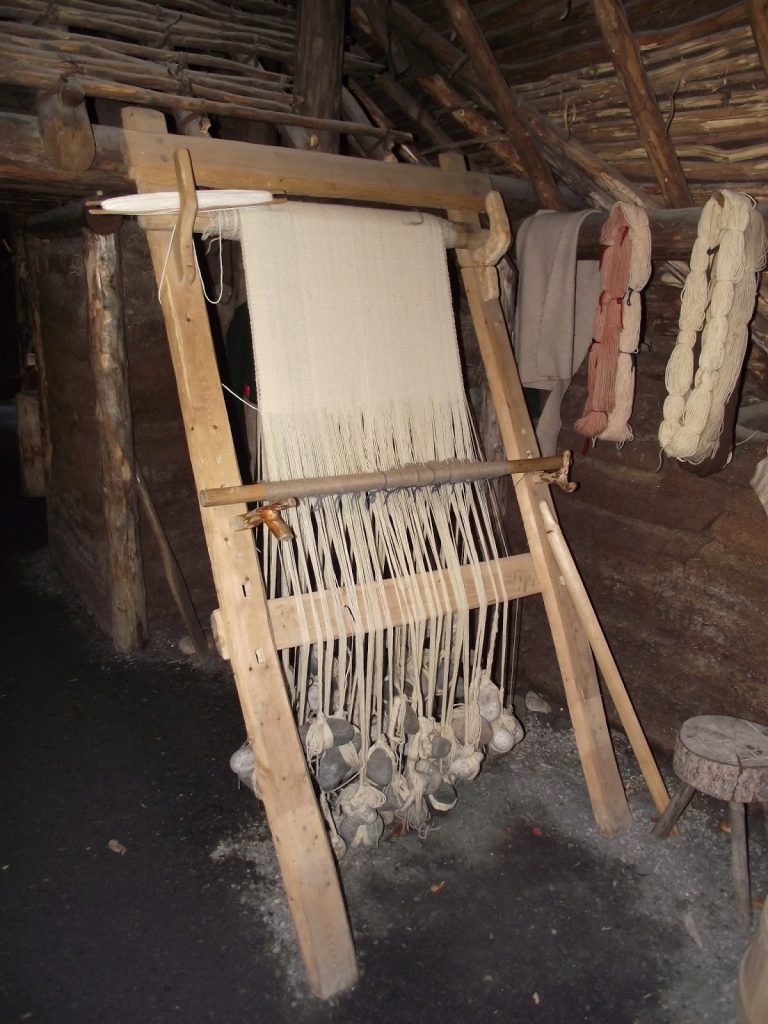
Women did. Almost entirely. The upright warp-weighted loom was a fixture in Icelandic households, and it was operated by women. They produced the cloth, regulated the quality, and in doing so they controlled the material the entire economy ran on.

Archaeologist Michele Hayeur Smith, who has studied textile production in the Viking North Atlantic for decades, found that the evidence for vadmal production points overwhelmingly to female craft networks. The women working those looms were not peripheral to the Icelandic economy. In a very direct sense, they were the economy.

The Gragas specified what a valid cloth unit had to look like. Which means the women weaving to that standard were, functionally, minting currency. Their labor was the labor that made exchange possible.

For centuries, Iceland had no king, no coin, and no central mint. It had law, assembly, and women at looms producing the medium that made everything else run.

A stone-weighted Viking loom, or warp-weighted loom, is an upright wooden frame where vertical warp threads hang down and are kept taut by tied stones or clay weights. It was essential in the Viking Age for producing dense wool garments, blankets, and ship sails.

Michele Hayeur Smith’s research on North Atlantic textiles found that vadmal quality held remarkably consistent standards across centuries of production, pointing to organized female craft networks rather than scattered household work. By some accounts, vadmal was also accepted in trade with Norway and Britain, which made it, in effect, a recognized export currency beyond Iceland’s shores.

Crochet does math.

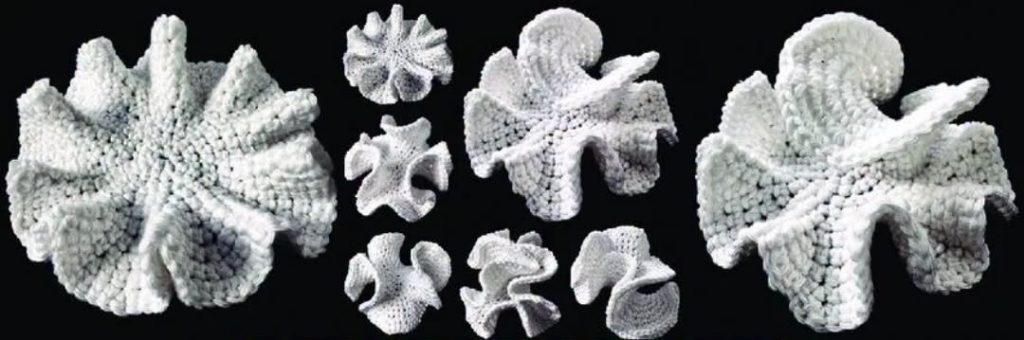
For generations, some of the world’s brightest mathematicians were trying to explain a shape that almost seemed to defy reality. Hyperbolic geometry—where space curves away from itself like ruffled lettuce or coral—was notoriously difficult to visualize. Professors folded paper, sliced models from cardboard, and carefully assembled delicate constructions that often tore apart before a semester was over. It was one of mathematics’ most frustrating teaching problems.

The breakthrough didn’t come from a laboratory. It came with a crochet hook.

In 1997, Latvian mathematician Daina Taimina was searching for a better way to teach her students when she noticed something unexpected. By adding stitches at regular intervals while crocheting, the fabric refused to stay flat. Instead, it rippled and curled into the very shape mathematicians had struggled for decades to demonstrate.

It looked almost too simple to be taken seriously.

Some colleagues initially assumed the colorful yarn models were little more than clever crafts. But the mathematics was exact. Every carefully placed increase produced an authentic hyperbolic surface—one that students could hold, bend, and examine from every angle without destroying it. Suddenly, an abstract concept that had baffled generations became something you could pass around a classroom.

The idea spread far beyond mathematics departments. Scientists used the models to explain everything from coral reefs and sea slugs to the folds of kale leaves and certain biological structures found in nature. Artists embraced the unexpected beauty of the forms, while educators around the world abandoned fragile paper models in favor of crocheted ones that lasted for years.

Perhaps the most remarkable part of the story is that one of the most elegant advances in teaching advanced mathematics didn’t require a supercomputer or expensive technology. It required recognizing that an ancient textile craft could solve a modern mathematical problem—a reminder that breakthroughs sometimes appear where no one thinks to look, until someone is willing to see them differently.

The Way We Were

Our Jill shares some memories of life in the ’60s.

Memories of Sheep

Jill Warren
 
The children were given a black, super fine lamb, Topsy,  in 1964. Well Topsy grew, was shorn and that was the beginning of my love for sheep and spinning.
 
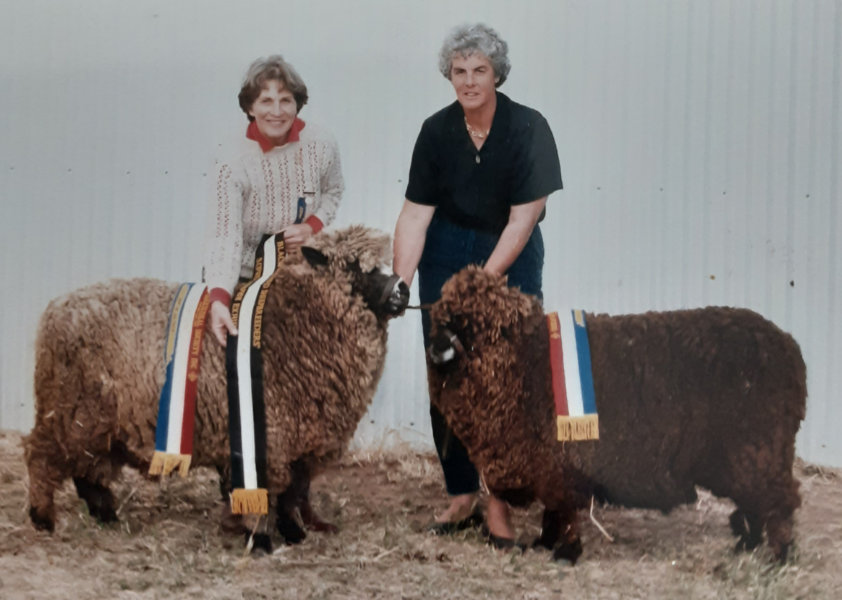
We moved to our farm at Eskdale and the sheep grew in numbers. I started showing them and took 5 ewes and a ram to Cobram.
 
 
Showed, bred and ate coloured sheep for another 10 years till we moved to another farm that didn’t have sheep fences. 
 
I had a friend, that bred pure corridale white sheep. She would ring me and say” I have a coloured lamb, come and get it before Richard knocks it on the head”. When grown, if it didn’t have the colour I wanted, or wool wasn’t even, we would eat it.
 
 
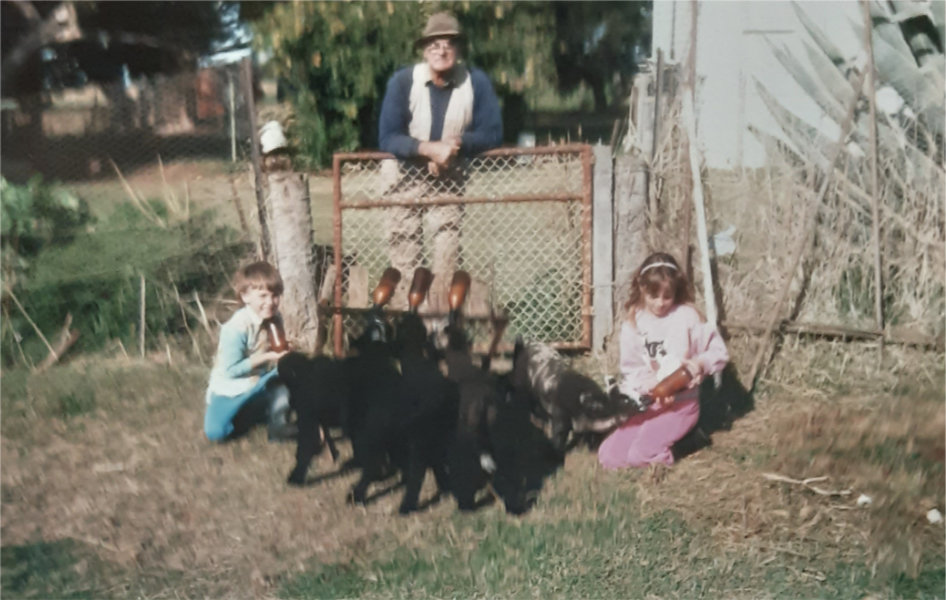
My dad built me a lamb feeding bar as you can see in the photo.
 
Dad, grandchildren Anita and Zac feeding 5 lambs.
 
Lambs drank, when they were a month old,  a beer stubby twice a day. I would fill the bottles at the dairy and feed lambs on the way home. One morning the tanker arrived to pick up milk. 2 empty stubbys sitting on the milk vat. The driver looked at me , with raised eyebrows. I said ” I have to drink 2 stubbies while I am milking”. He told everyone in the district!!!
 
One show I came home with a 6 month old angora goat. Gordon wasn’t impressed, but I said I will get him shorn then we will eat him. Got Billy Joe shorn and he was sooo small without his hair, Gordon said fatten him up. Well Billy Joe taught all my sheep to stand on their back legs, and eat the leaves off the fruit trees and how to get up on round hay bales.
 
Another shearing and off Billy went to the abattoir.  Gordon’s brother, Darryl wife and kids came for holiday.  Roasted a leg, potatoes, vegetables and gravey for lunch. Asked them how it was. Lovely they said. I said you just ate Billy Joe. 

Fleecy Follies - fur, feathers and spikes!

FF_IMG_1536

Fur

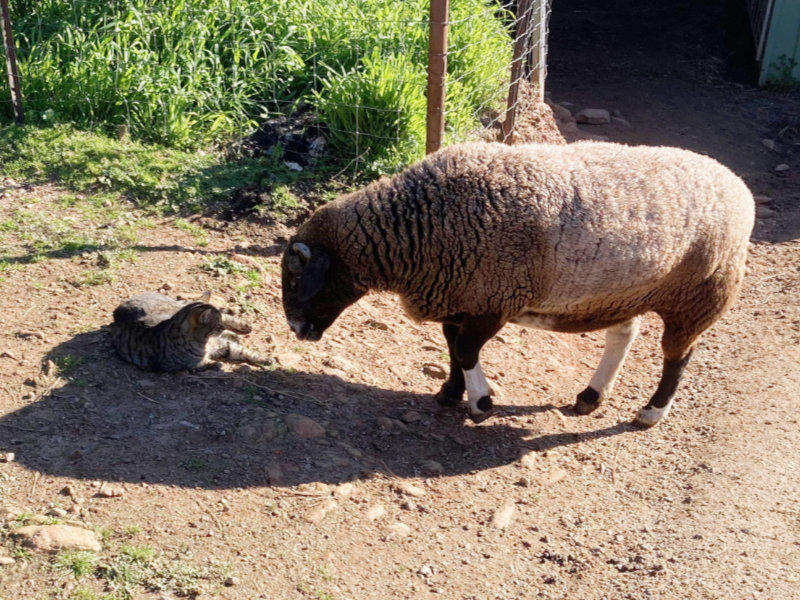
It is said that cats mostly meow only to humans. Abi didn’t read the cat’s meow handbook. She often meows to our old poddy dorper cross sheep Blue Juice. He seems intrigued by her and often approaches her when she’s sunning herself in the paddock. While Abi does not like him getting too close, they will frequently cautiously greet each other nose-to-nose.

Blue Juice is nearly 12 years old and becoming quite arthritic. He rarely wanders far from the alpaca girls’ shed and when standing will often raise one foot off the ground, then swap to the other. He’s slower than he used to be but that does not stop him running for food treats!
Feather Sheep

Periodically we evict surplus or aggressive roosters from the hen house, and push them into the rooster run. It is fenced but unlike the hen’s run it is not covered. It does however have a lot of grass and tree lucerne growing in it providing feed, shade and roosting sites.

Some roosters always manage to fly the coop to play chicken with the foxes. Most fly back in. These two bad boys however won’t. They seem to be leading a charmed life or are just too ornary for the foxes to contend with. They have decided the sheep’s orchard paddock is great, and sheep supper pellets are delicious. They just won’t leave or go back to the protected run. They have been dubbed our “feather sheep”.
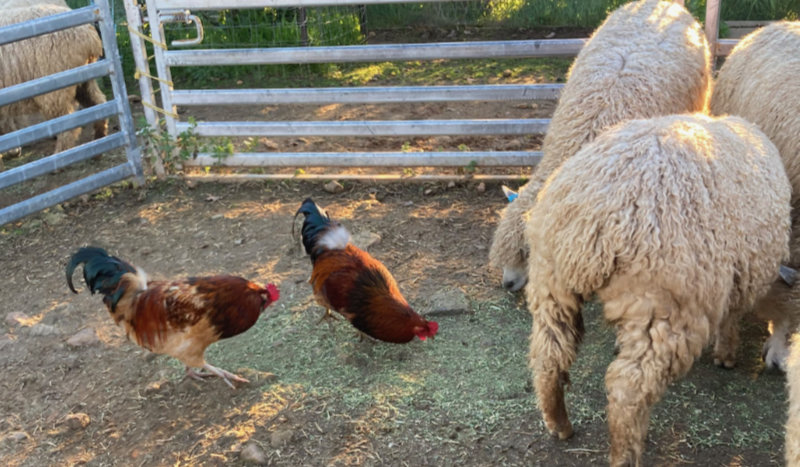
During the first few days in the sheep’s orchard one of the sheep kept following them around and the rooster didn’t know what to do. Now they hang around when the sheep get their evening feed and help themselves to the sheep pellets. Every now and then there is a startled rooster-squawk as the sheep, oblivious to the roosters bad tempers, crowd them out of the way. 

More Feathers

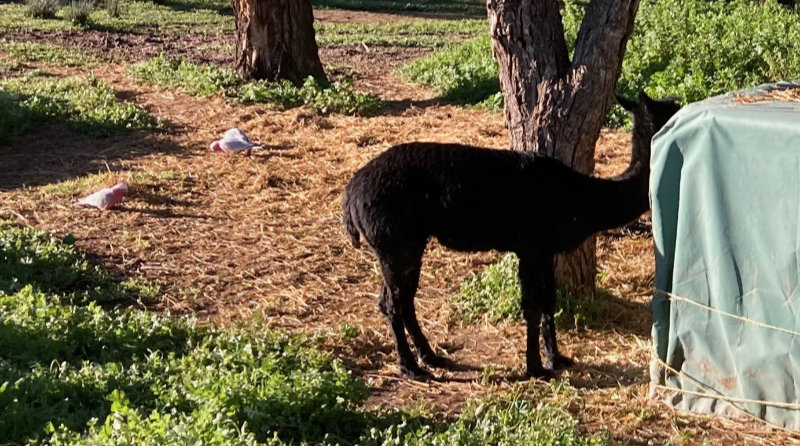
Roosters are not the only feed thieves. Galahs hunt through the discarded hay for any sign of fallen grains. Crested pigeons and magpies pinch their fair share of pellets and any fallen grain.
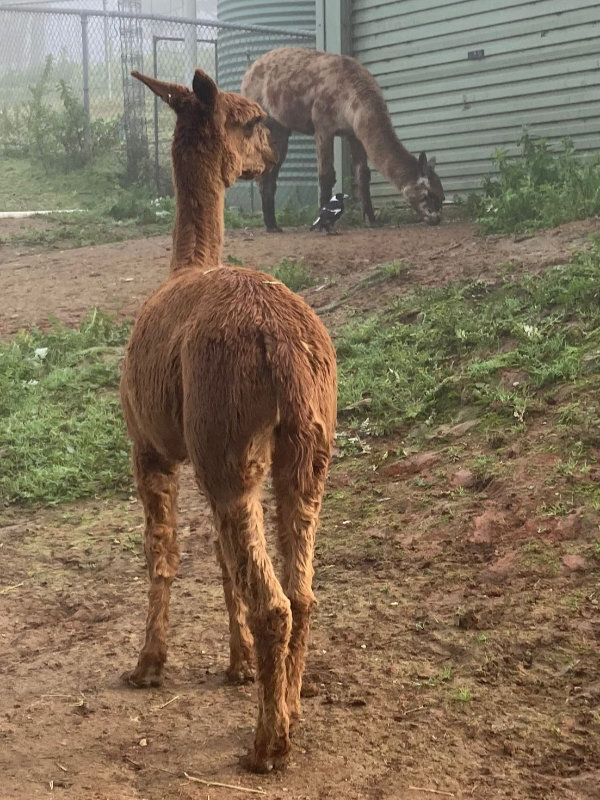
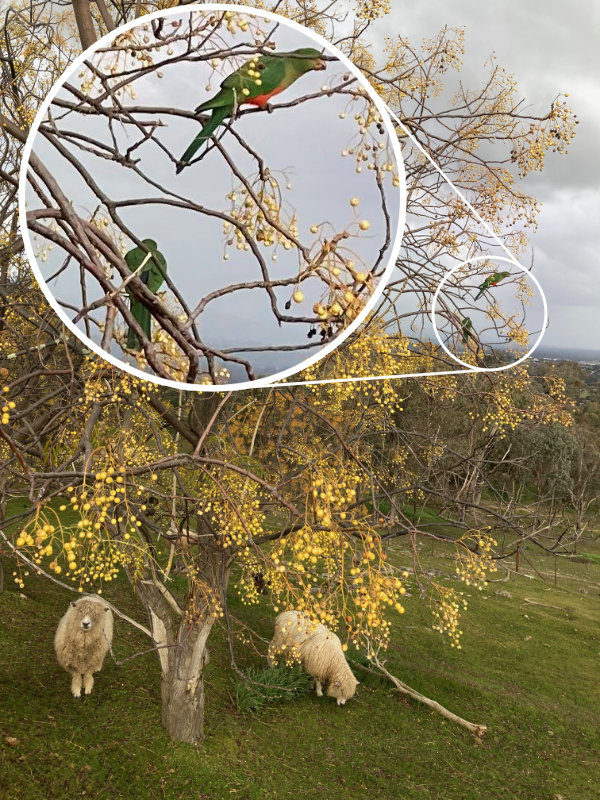
Every winter the magnificent King Parrots visit the White Cedar trees after the ripe berries. Usually one or two males and a collection of females and juveniles.
There has also been a big up-tick in the number of Kookaburras hunting in the paddocks. Sitting on fence posts, gates or tree branches waiting watching and listening for any sign of a feed. Neither the sheep nor the alpacas seem overly concerned about their feathered neighbors.

And spikes!

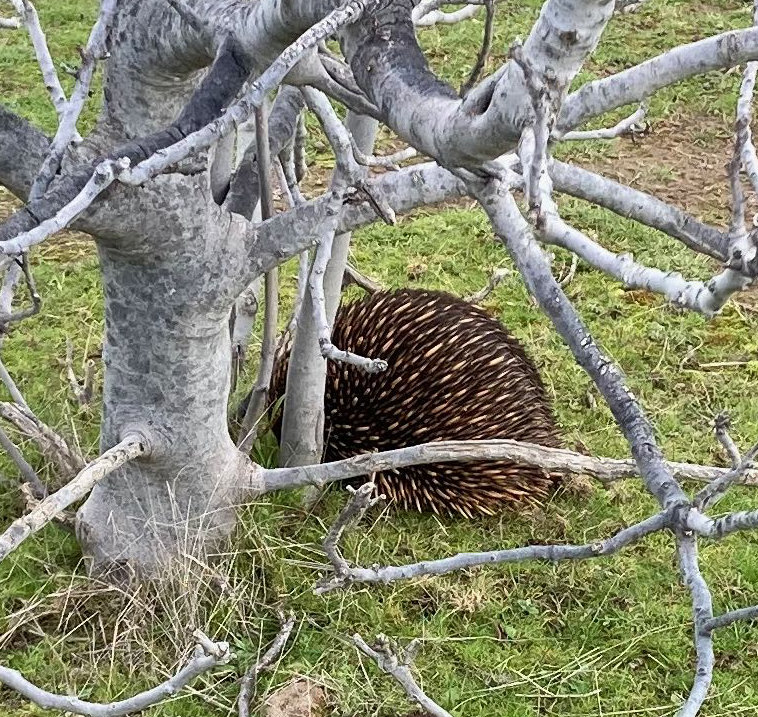
Every year we see these lovely echidnas scavenging through the property. Sometimes with a herd of alpacas in tow. This big fella was poking around the fig trees in the orchard. The sheep didn’t seem to care.
FOMO

Fear Of Missing Out … Early afternoon I usually clean the discarded hay from the alpaca girls morning feed. Although it’s perfectly good hay, once they’ve pulled it out of the feeder and dropped it on the ground, and stood in it they won’t eat it. Sheep however are not as fussy!

The fallen hay is scooped up into chaff bags and dropped over the fence for the sheep.

Sometimes however the sheep are off somewhere grazing and don’t see the hay going over. As soon as the first one back realises what’s on offer the race is on!
2026 Program - a work in progress

January 7thRhonda and Heather will attend to clean out the rooms after the insect bombs.
January 14thAmanda will open up.
January 21stJulie will open up.
January 28thCancelled due to extreme heat forecast
February 4thCasual Workday
February 11thFirst Business Meeting for 2026
February 18thCasual Workday
February 25thCasual Workday
March 4thCasual Workday
March 11thBusiness meeting
March 18thCasual Workday
March 25thDyeing Day
April 1stCasual Workday
April 8thBusiness Meeting
April 15thCasual Workday
April 18thWangaratta Wool Day, 9am-3pm Milawa Community Hall.
April 19thB & C Sheep Ass. Woolfest 2026 Mittagong RSL. 10 am to 4pm
April 22ndCasual Workday
April 29thCasual Workday
May 6thCasual Workday
May 13thBusiness Meeting
May 16th & 17thCanberra Wool Expo, 9:30 - 2:30 Old Bus depot Markets Canberra
May 20thCasual Workday
May 27thCasual Workday
June 3rdCasual Workday
June 6thShepparton Wool & Fibre Fair 10:00am - 3:00pm,
St Augustines Parish Church Hall, Orr Street, Shepparton.
June 10thBusiness Meeting
June 17thCasual Workday
June 24thCasual Workday
July 1stCasual Workday
July 8thBusiness Meeting
July 15thCasual Workday
July 17th – 19thAustralian Sheep & Wool Show (Bendigo) from 9.00 am to 5.00 pm Friday & Saturday, from 9.00 am to 4.00 pm Sunday. At the Bendigo Showgrounds.
July 22ndCasual Workday
July 29thCasual Workday
August 1st - 2ndSouth Coast Fibre Muster - from 10.00 am to 3.00 pm Saturday & Sunday. At the Berry School of Arts.
August 5thCasual Workday
August 12thAGM, Business Meeting & Guild’s Birthday
August 19thCasual Workday
August 26thWarping Workshop
September 2ndCasual Workday
September 9thBusiness Meeting
September 16thCasual Workday
September 23rdCasual Workday
September 30thCasual Workday
October 7thCasual Workday
October 14thBusiness Meeting
October 21thCasual Workday
October 28thRooms closed for Albury Show
November 4thRooms closed for Albury Show ???
November 11thBusiness Meeting
November 18thCasual Workday
November 25th
December 2ndCasual Workday
December 9thBusiness Meeting, Christmas Lunch
December 16thTBA

Last words ...

A few housekeeping items:
1 – Some members have been getting spam type emails saying they are coming from Guild members. If anyone gets a suspicious looking message, do not open it or any links within it.
2 – Please do not park in front of the Guild’s side double doors or the undercover area. Park on the grassy areas only.
3 – The drain area outside the Guild door that fills up with water when it rains is becoming DANGEROUS with one of our members slipping in the mud and algae growing there. PLEASE KEEP WELL CLEAR OF THE DRAIN AND MUD even when it appears dry!

Newsletter contributions are always welcome. So, if anyone has anything they want to contribute, or requests for articles, email me!

Cheers for now,
KathyW, Ed.

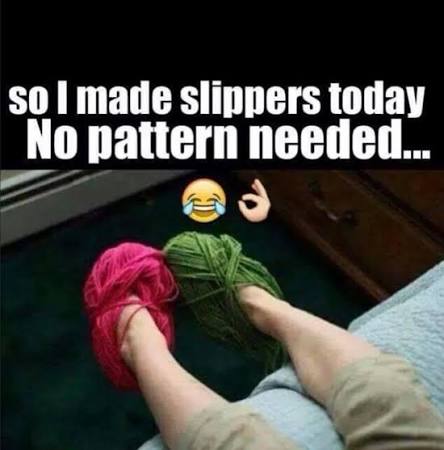
When crochet patterns drive you crazy ...